
Australia is in wartime.
Not the industrial, territorially bounded war like that of the mid-twentieth century. It’s a subtle, creeping, distributed, chronic war that plays out across psyches, cultures, technologies, ecologies, and nervous systems. We are living through physical wars abroad, cyber wars, information wars, and relentless contests over our attention, identity, and the meaning of our shared reality. These pressures are layered atop economic insecurity, rising geopolitical tensions under resurgent ethno-nationalist movements internationally, ecological anxiety, rapid technological change and the spectre of AI and more.
This is a new kind of war — one without clear front lines or definitive endpoints. In many ways it’s a war we’ve wrought upon ourselves through the systems we’ve built and the ways we’ve organised modern society. And it’s a war that targets the very foundations of our social fabric. How we cultivate trust in ourselves, each other and our institutions. How we make sense of the world together and how meaning flows and moves through our individual and social bodies. It’s about our identities as diverse people, ancestries and cultures, and our capacity to relate across difference while we experience profound uncertainty and systemic change at the same time.
In December 2025, an attack declared as a terrorism incident by police took place on unceded Gadigal land, Bondi Beach, Sydney, Australia and led to many lives lost. We’d be remiss to ignore that this as a symptom of this broader context. A signal of deeper stresses playing out at multiple levels of Australian society that are also patterns of systemic fracture globally.
But in this Australian context, the establishment of the Royal Commission into Antisemitism and Social Cohesion is both understandable and necessary. Antisemitism causes real harm. Jewish Australians deserve safety without qualification. As do all people, regardless of background, ancestry, or belief that does not promote harm or hatred.
Recent protests, counter-protests, and acts of political violence across the ideological spectrum exploded here in Australia last year after the monumental March for Humanity over the Harbour Bridge on unceded Gadigal lands in support of human rights and opposition to the genocide taking place in Gaza.
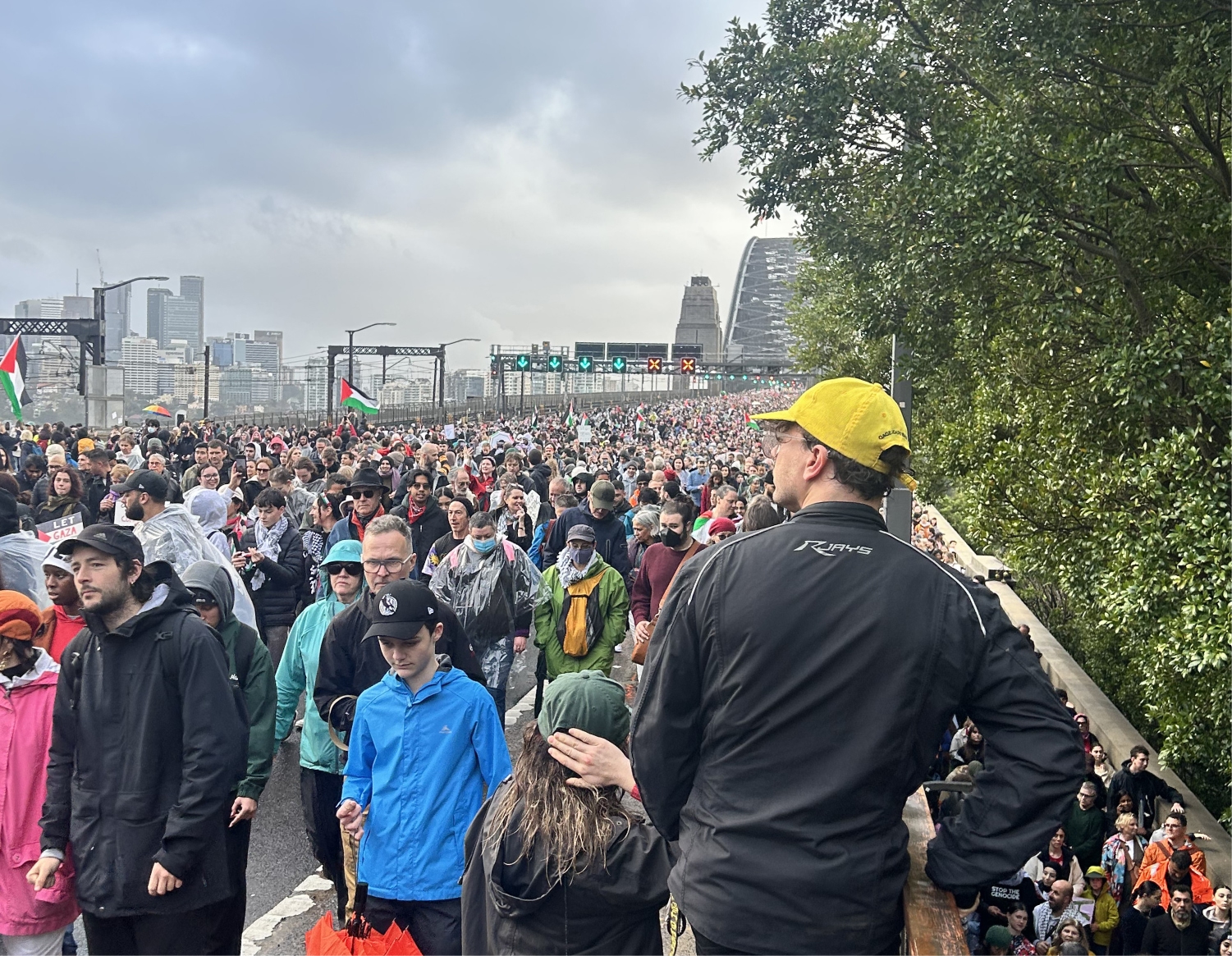
Further far-right led protests ensued. And lest we forget the despicable attack on women and Elders at Camp Sovereignty, Naarm, led by known neo-nazi, Thomas Sewell. These events underscore the urgent need to address hate, prejudice, and social fracture.
Social trust is clearly under strain, and political and community leaders, and entire institutions are searching for ways to hold a plural society together under unprecedented pressure. The times are indeed fraught.
And there is a risk embedded in the language and assumptions shaping this moment. In responding to antisemitism and social fracture, Australia may default to a model of cohesion that is poorly suited to the kind of war we are actually in.
The key areas the Royal Commission is tasked with investigating are:
- Tackling antisemitism by investigating the nature and prevalence of antisemitism in institutions and society, and its key drivers in Australia, including ideologically and religiously motivated extremism and radicalisation.
- Making recommendations that will assist law enforcement, border control, immigration and security agencies to tackle antisemitism, including through improvements to guidance and training within law enforcement, border control, immigration, and security agencies to respond to antisemitic conduct.
- Examining the circumstances surrounding the antisemitic Bondi terrorist attack on 14 December 2025.
- Making any other recommendations arising out of the inquiry for strengthening social cohesion in Australia and countering the spread of ideologically and religiously motivated extremism in Australia.
In this essay I will not be tackling antisemitism in any specific depth or it’s socio-historical origins, nor addressing the events that unfolded in the attack that catalysed the call for this Royal Commision. But I will be touching on themes directly relevant to areas 1 and 4. These represent the broader social and systemic dimensions of the Royal Commission’s work and what should not be muted as to the depth and root causes of these drivers. In my view ignoring them would be an intergenerational travesty.
Antisemitism and systemic stress
Antisemitism and hate or prejudice of any kind should never be excused, minimised, or relativised in the name of political correctness. At the same time, if responses are to be effective over the long term, they must be grounded in an accurate diagnosis of the conditions in which antisemitism and other forms of prejudice, racism and radicalisation are intensifying in Australia and globally. And while I am not going to dive into the global situations in detail as they are complex and multifaceted, I do want to highlight one key pattern that is often overlooked…
the role of systemic stress in driving identity compression and moral rigidity.
This is not simply a story of extremist ideology or moral failure. It is also a story of systemic stress we are all living through.
Under prolonged uncertainty, and chronic systemic stress, human nervous systems narrow. Cognitive complexity collapses. Difference is experienced less as something to be negotiated and more as something to be defended against. Think about how you feel when you are chronically stressed or sleep-deprived. Your capacity for nuance, empathy, and flexible thinking diminishes. You seek certainty, clear boundaries, and simplified narratives. For example, as a parent, when I am exhausted and overwhelmed, I find myself less patient with my children’s disagreements and more inclined to enforce rigid rules for the sake of order. This is a natural nervous system response to stress consistent with research across neuroscience and psychology. From polyvagal theory to studies on allostatic load, the evidence is fairly clear: under sustained threat, we prioritise survival mechanisms over complex reasoning and perspective-taking.¹
So in the conditions we are living through, people gravitate toward parochial identities that promise certainty, belonging, and moral clarity. It’s a pattern. Antisemitism is one expression of this broader pattern of identity compression under sustained pressure.
Treating antisemitism solely as a problem of beliefs to be corrected or suppressed risks addressing symptoms while leaving underlying dynamics and the realities of this transformative period we are all living through untouched.
The hidden assumptions of “social cohesion”
The language of social cohesion is now central to public discourse in Australia. As sociologist Andrew Jakubowicz shared in a piece last year, the term is frequently invoked to signal unity, safety, and inclusion, yet often remains shallowly defined and inconsistently applied. It tends to function as a policy aspiration and narrative tool rather than a lived social practice that emerges.
Historically, this is not surprising. The term cohesion rises distinctly in public usage after the Second World War and the Cold War that followed.
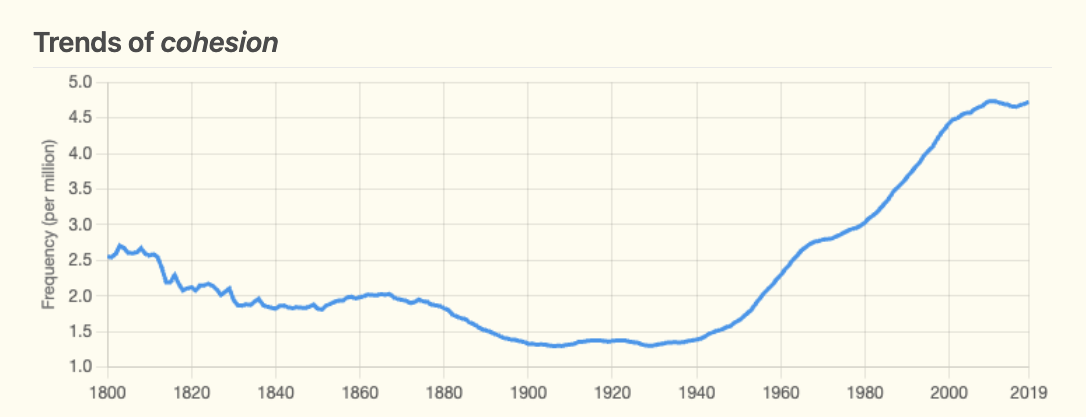
Cohesion, etymologically, refers to sticking together — adhesion, binding, alignment. In periods of total and material war, where threats are external, existential, and time-bounded, cohesion makes sense as a coping mechanism. Difference becomes dangerous. Unity becomes survival. And if you’ve ever been in a high-stakes team situation like a firefight, or a rescue operation you know that cohesion is vital. In those moments, the group must act as one. Divergence can lead to failure or death.
But this type of wartime logic has quietly carried forward into a very different historical moment.
Today’s war does not sit outside society. It flows through it. And in such a context, the assumptions underpinning cohesion need to be re-examined.
Why cohesion fails in this kind of war
The war we are in now targets cognition, attention, trust, meaning and identity. It has no clear front line, no single enemy, and no obvious end point. In such conditions, strategies optimised for cohesion can easily backfire.
Cohesion emphasises alignment. It reduces variance. It privileges sameness and legibility. In the short term, this can dampen visible conflict. In the longer term, it increases latent fragility.
When alignment is enforced under conditions of chronic stress, three things tend to happen. Nervous systems move further into sympathetic overdrive. Identity flexibility collapses, pushing people into narrower moral and cultural camps. Internal differences begin to register as threats rather than resources.¹
Paradoxically, efforts intended to strengthen social cohesion can intensify polarisation and conservative retrenchment. The system appears quieter, but it becomes more brittle.
This is not a moral critique. It is a systems observation.
What the data actually shows
Australia’s long-running Mapping Social Cohesion research, conducted by the Scanlon Foundation Research Institute, provides a useful empirical grounding. The 2024 findings show that while measures of cohesion such as trust, belonging, and acceptance of multiculturalism have declined from recent peaks, they remain relatively stable and well above collapse levels. Support for multiculturalism remains high, even as economic stress, housing insecurity, and institutional distrust exert pressure.
What this data suggests is not social breakdown, but persistent strain. The social fabric is being worn, not torn apart.
Crucially, these indices measure cohesion as adhesion — the degree to which people feel connected or aligned. They do not capture a society’s capacity to remain viable under sustained perturbation. They do not distinguish between enforced alignment and adaptive resilience.²
From cohesion to coherence
This is where a different concept becomes important: coherence.
Coherence is not about sticking together. It is about viability.³ A coherent system can absorb disruption, tolerate difference, and reorganise without collapsing or turning on itself. It maintains identity and relational integrity under stress, rather than suppressing variance to preserve surface order. Think about it like this, you are trying to walk a tightrope. Cohesion is like holding perfectly still to avoid falling. Coherence is like learning to sway with the rope’s movements while maintaining your balance. State vs trait.
In wartime conditions that operate through cognition and culture, coherence is the appropriate response mode. It prioritises nervous-system regulation over symbolic enforcement, local relational infrastructure over national moral signalling, and adaptive pluralism over uniformity.
Coherence does not mean moral relativism. Boundaries still matter. Maintaining difference and preventing harm still requires clear response. But the primary aim shifts from enforcing sameness to strengthening the social capacities that allow difference to coexist without escalation. At a time where identity is under siege, coherence supports the flexibility needed to navigate complexity without fracturing under the strains of significant change we are all living through.
What coherence looks like in practice
If coherence is the aim, what does it actually look like as practice?
At the individual level, it looks like nervous system regulation — the capacity to encounter difference without immediately moving into fight, flight, or freeze. This is not stoicism or suppression. It is the cultivated ability to hold complexity without collapsing into simplification. Practices that support this are well-documented: contemplative traditions, somatic work, relational repair, adequate rest, connection to place and community. We are all in sympathetic overdrive right now. Building coherence starts with learning to return to a regulated state from which complex engagement is possible.
At the community level, coherence shows up as relational infrastructure — the web of relationships that allows conflicts to be metabolised rather than merely managed. This includes local institutions where people encounter each other across difference: schools, sporting clubs, neighbourhood gatherings, shared civic projects. These spaces are not about getting everybody together in agreement. They are about the repeated experience of navigating difference without rupture. We do have such events and spaces in Australia, but they are often under-resourced and undervalued compared to more visible, large-scale initiatives, particularly those driven by media or political agendas, or sporting spectacles.
At the institutional level, coherence requires a different posture than command-and-control. It means investing in conditions that support local adaptive capacity rather than mandating uniform compliance. It means distinguishing between situations that require clear boundaries and rapid response (genuine safety threats) and situations that require patient relationship-building (persistent social strain).
None of this is quick or easy. Coherence is harder to measure than cohesion. It resists being reduced to indices or KPIs. It’s more about movement and transformative adaptation than static metrics. But it is what actually sustains plural societies under prolonged pressure.⁴
The risk and opportunity before us
The risk facing Australia is not that antisemitism will continue. The risk is that, in the name of cohesion, responses will over-correct toward what might be called enforced synchronisation — the attempt to align large-scale social systems through top-down coordination rather than emergent mutual adjustment.
This shows up as familiar policy moves: tighter surveillance, broader speech controls, symbolic boundary enforcement, and simplified narratives of unity and threat. Each of these can be justified individually. Together, they form a pattern that privileges legibility and control over the messier work of building relational capacity amongst diverse communities and worldviews.
We’ve already seen some of these dynamics play out. How we respond now will set precedents for years to come. It may lock us into path dependencies that are hard to reverse — ones that none of us want to live with.
In a war that runs through attention, identity, and meaning, such strategies can inadvertently strengthen the very dynamics they seek to contain.
An invitation to think differently
The Royal Commission represents an opportunity to update our social doctrine for the war we are actually in. That requires distinguishing cohesion from coherence, and recognising that alignment and viability are not the same thing.
This distinction is not merely conceptual. It emerges from ongoing research into how individuals, organisations, and collectives develop and sustain adaptive capacity under systemic stress — work I am pursuing through the University of Wollongong and in collaboration with various communities and institutions. The patterns described here — identity compression under stress, the fragility of enforced alignment, the difference between surface quiet and genuine resilience — are observable dynamics, not just theoretical claims.
This piece is offered as a contribution to public discussion. I am interested in engaging with others across community, research, policy, and civil society who are concerned that well-intentioned responses to antisemitism and social fracture may unintentionally deepen long-term fragility.
If sufficient shared ground emerges, this conversation could form the basis of a collaborative submission to the Royal Commission.
For now, the task is simpler and harder at once: to hold our ground without hardening. To name antisemitism and hate clearly while understanding the conditions that intensify it. To choose responses that increase our capacity to remain human, plural, and viable — not just in this moment, but through the longer war we are living through together.
If you’re working on related questions — in research, policy, community organising, or elsewhere — I’d welcome the conversation. You can reach me at m3untold@gmail.com.
Notes
¹ The relationship between chronic stress and cognitive narrowing is well-documented in neuroscience and psychology literature. Under sustained threat, the prefrontal cortex — responsible for complex reasoning, perspective-taking, and impulse control — becomes less dominant, while more reactive brain regions take precedence. This is adaptive in acute danger but maladaptive when the “threat” is ambient and ongoing. See work by Stephen Porges on polyvagal theory, and Bruce McEwen on allostatic load.
² Scanlon Foundation Research Institute, Mapping Social Cohesion 2024. The annual survey measures five domains: belonging, worth, social justice, participation, and acceptance. While valuable, these metrics capture felt experience of connection rather than systemic capacity to absorb and adapt to perturbation.
³ The distinction between coherence and entrainment draws on dynamical systems theory. Entrainment refers to the synchronisation of oscillating systems — useful for coordination but potentially constraining. Coherence refers to a system’s capacity to maintain functional integrity across different states. A coherent system can tolerate internal variation; an entrained system requires alignment. Both have their place, but they serve different purposes.
⁴ I have been exploring these dynamics also through agent-based computational modelling as part of ongoing research. Key findings: (1) Below a stress threshold, alignment-optimised and coherence-optimised systems perform equivalently — the difference only becomes visible under sustained pressure; (2) Under repeated perturbation, alignment-optimised systems accumulate a “hidden tax” of constant recovery effort that never fully succeeds; (3) When systems provide “escape valves” — ways for agents to return to their own position during perturbation — these must be universally available. If only some agents can access relief while others remain subject to alignment pressure, the social field fragments and those without escape valves oscillate between conflicting signals, increasing rather than decreasing cascade risk.