I built a simple agent-based model to test an intuition about collective resilience. The intuition was wrong. The way it was wrong matters.
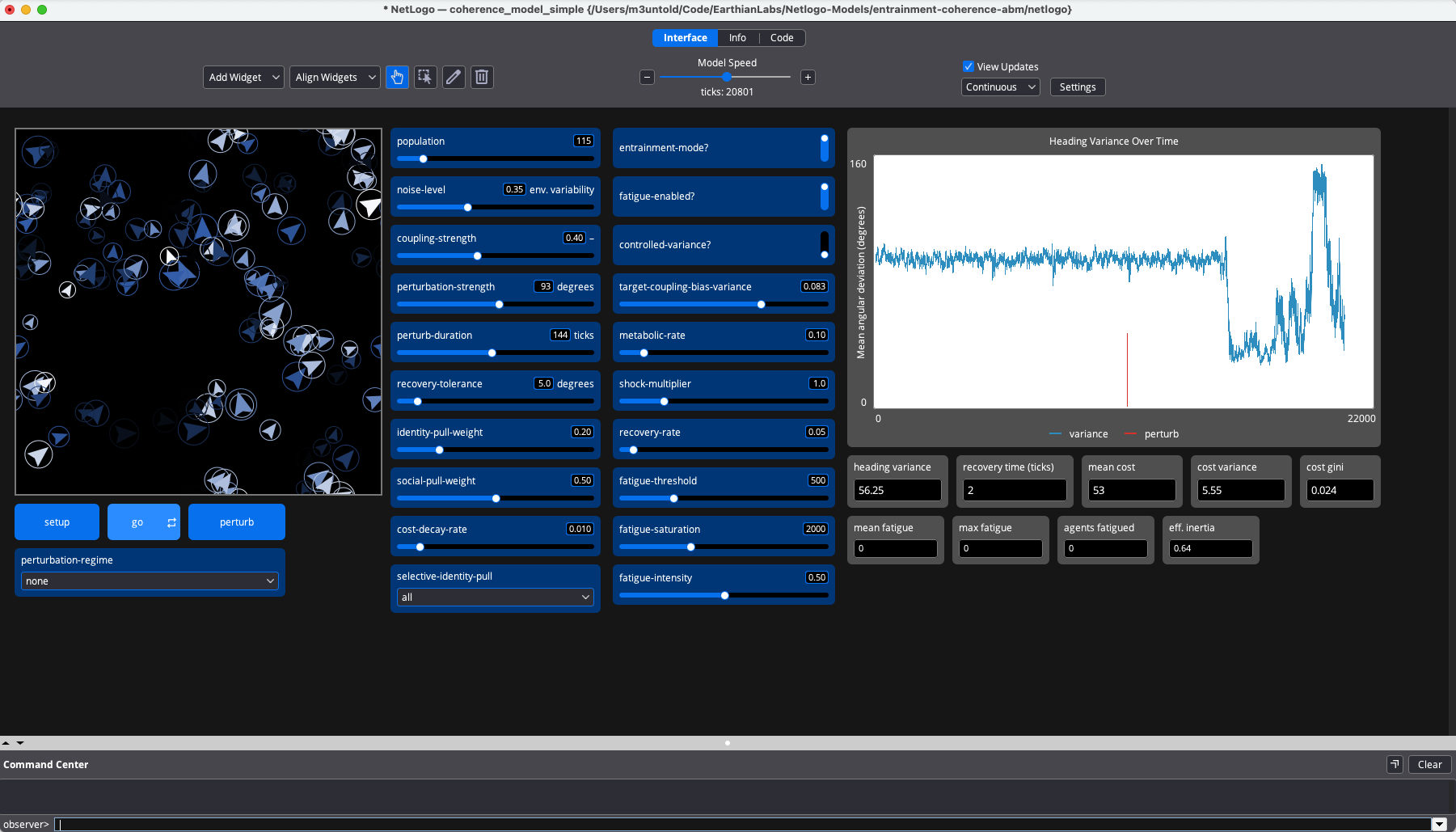
The model is straightforward: a population of agents trying to coordinate their heading while maintaining some sense of who they are. Some agents are more sensitive to the group consensus than others. Some have stronger internal reference points. The question was whether systems that preserve internal diversity—what I’m calling coherence—perform better under stress than systems optimised for alignment—entrainment.
The theorem I’ve been testing:
In agent-based systems with heterogeneous identity and bounded coupling, regimes that preserve internal diversity will exhibit lower peak disruption and faster recovery under repeated perturbation than regimes optimised for phase alignment.
The first round of experiments supported this. Under high stress, coherence-mode systems recovered 12 times faster than entrainment-mode systems. Entrainment looked efficient at baseline but brittle under load. Coherence looked messier but absorbed perturbation without cascading.
Then I tried to find out why.
The Load-Bearer Problem
When you watch entrainment systems fail, a pattern emerges. Certain agents bear disproportionate stabilisation work. They’re the ones with high social sensitivity positioned far from consensus—constantly adjusting, constantly paying alignment costs, keeping the collective from fragmenting.
I started calling them load-bearers. About 22% of the population in a typical run. They do 1.6 to 2 times the coordination work of everyone else.
In entrainment mode, when stress persists, these agents exhaust themselves. Their turning capacity degrades. The system spirals—not because everyone fails, but because a specific subset runs out of capacity and the burden has nowhere else to go.
In coherence mode, this doesn’t happen. Agents have access to their preferred heading—an independent reference point they can fall back to when the collective field becomes too costly to track. It works like a relief valve. When load-bearers get tired, they can pause, reorient to something stable, recover.
So I formed a hypothesis: protecting the load-bearers prevents cascade.
Seemed obvious. If the high-coupling agents are the ones who spiral the system, give them the escape valve and leave everyone else in entrainment. Selective protection for those who need it most.
I ran the experiment. Four conditions, 50 runs each.
Condition A: Only load-bearers get identity-pull (the relief pathway). Condition B: Only non-load-bearers get identity-pull. Condition C: Everyone gets identity-pull (baseline coherence). Condition D: No one gets identity-pull (baseline entrainment).
Pre-registered predictions:
- Condition A should show near-zero cascade failures.
- Condition B should fail at about the same rate as pure entrainment (~10%).
- Conditions C and D would anchor the comparison.
What Actually Happened
Condition A—the one where I protected only the load-bearers—showed a 10% spiral rate. The highest of all conditions.
Condition B—where I forced load-bearers into pure entrainment and let everyone else opt out—showed 0% spirals. Completely stable.
Condition C (universal coherence) showed 0% spirals, as expected. Condition D (pure entrainment) also showed 0%, though that’s likely sampling noise—earlier experiments put it around 10%.
The prediction wasn’t just unsupported. It inverted.
Protecting the load-bearers made things worse. Leaving them exposed while protecting everyone else worked fine.
Phase Misalignment Cascade
Here’s what I think is happening.
When you give high-influence agents an escape valve but keep low-influence agents locked into entrainment, you create a mixed coupling regime. The social field fragments.
Load-bearers, when stressed, fall back to their preferred heading. Non-load-bearers, still in pure entrainment mode, try to follow the group consensus. But the group consensus is now split—some agents at identity, some trying to entrain.
The low-influence agents oscillate. They’re tracking a target that’s no longer coherent. The high-coupling agents, who are supposed to be protected, feel this oscillation as increased alignment cost. The escape valve doesn’t help because the field they’re coupled to has become incoherent.
Costs accumulate. Fatigue kicks in. The spiral triggers.
When you protect only the non-load-bearers, the opposite happens. The load-bearers, who have high responsiveness, quickly realign to the social field. The non-load-bearers drift toward their preferred headings but they don’t dominate the consensus—they’re weak-influence by definition. The social field remains structurally coherent because the agents who matter most for collective alignment are still doing their job.
Letting weak agents opt out is harmless. Letting strong agents opt out is catastrophic.
What This Means
The relief pathway only works if it’s universal.
Selective escape valves don’t protect systems. They destabilise them. When high-influence nodes exit while others remain coupled, the “protection” becomes the mechanism of collapse.
This has implications I’m still working through.
If you’re designing organisational resilience strategies and you give managers the option to step back during crises while frontline workers remain in high-coordination mode, you may be engineering exactly the configuration that cascades. The manager’s exit fragments the field the workers are trying to track.
If you’re designing governance protocols and you grant veto rights to stakeholders with disproportionate influence, you create the conditions for phase misalignment. When key actors exercise autonomy, the rest of the system oscillates.
If you’re thinking about attentional economies and you allow influencers to detach while their audiences remain engaged, you set up a dynamic where the audience pays the oscillation cost.
The intuition that protecting the most-loaded nodes stabilizes the system is not just wrong. Acting on it creates the outcome you’re trying to prevent.
The Coherence Theorem Still Holds
Despite the falsification, the original theorem is intact. Systems that preserve internal diversity—where everyone has access to an independent reference point—show dramatically better recovery under stress. The mechanism is the relief pathway. But it has to be universal.
Partial coherence is worse than no coherence.
Under moderate stress (perturbation strength below ~30), the distinction doesn’t matter. Both regimes perform equivalently. Above that threshold, the regimes diverge. Entrainment shows superlinear degradation. Coherence scales linearly. The gap widens as stress increases.
The 12× recovery advantage isn’t an accident of parameterisation. It’s structural. When agents can fall back to something stable independent of the collective, they don’t externalise their exhaustion onto others.
What I missed initially was assuming you could give that capacity to a subset and call it done. You can’t. The coupling architecture is what matters, not the individuals. If some agents have autonomy and others don’t, and those agents have unequal influence, you’ve built a system primed for phase misalignment.
Where I’m Sitting Now
I ran this model to clarify an idea. The idea clarified, but not the way I expected.
The question I’m sitting with: how many systems we’ve designed—organisations, protocols, governance structures—operate under the assumption that selective relief for high-load nodes is protective?
And how many of those systems are actually engineering their own fragility?
The model is simple. Agents, headings, coupling. Real systems are messier. But if the mechanism holds—if heterogeneous access to autonomy in heterogeneous-influence systems creates phase misalignment cascades—then we’ve been solving the wrong problem.
We’ve been asking: who needs protection most?
We should be asking: does everyone have somewhere stable to return to when they’re spent?
If the answer is no, or if the answer is “only some people,” the system is already primed to fail. The spiral isn’t a matter of if. It’s a matter of when stress crosses the threshold and the strong agents exit, leaving everyone else to track a field that no longer exists.
Acknowledgements
This work draws on regulatory cybernetics (Ashby’s Law of Requisite Variety), allostatic load theory (Sterling, McEwen), and Varela’s enactive approach to cognition. The coherence/entrainment distinction builds on dynamical systems thinking about trajectory integrity versus local synchronisation.
The broader research program investigates transformative adaptation—how individuals and collectives develop adaptive capacity under systemic stress. This experiment is one small probe in the larger Becoming Earthians inquiry arc.
You can find the model code, notebooks, and experiment logs in my GitHub repository.
Further Reading
- W. Ross Ashby (1956) — An Introduction to Cybernetics — requisite variety as regulatory constraint
- Peter Sterling & Joseph Eyer (1988) — “Allostasis: A new paradigm to explain arousal pathology” — homeostasis vs. allostasis distinction
- Francisco Varela et al. (1991) — The Embodied Mind — enaction and autonomy