
Adaptation Archetypes
Research Question
How might serious play surface and reframe the postures people occupy under conditions of systemic stress — and open pathways toward transformative adaptation?
Methods
- action research
- serious play
- interactive narrative
- specification-driven development
Ethical Commitments
- non-pathologising framing
- postures not identities
- invitation not prescription
- honouring ambivalence
Research Context
How do people relate to systemic stress? What patterns of awareness, agency, and response emerge under conditions of ecological and civilisational uncertainty?
This project began as a personal inquiry during a period of creeping nihilism — noticing recurring patterns in myself and others when facing collapse narratives. Rather than pathologise these responses, the research asks: What if each pattern carries both shadow and gift? What if they’re postures we move through, rather than identities we’re trapped in?
Theoretical Framework
The project draws on multiple traditions to frame archetypal patterns as temporary postures rather than fixed personality types:
Core ontological principle: An archetype describes a temporary posture a person or group may occupy under conditions of stress. People move between postures across time, context, and scale.
Key frameworks:
- Holling’s Adaptive Cycle — postures as phase positions in dynamics of collapse and renewal
- Active Hope (Macy & Johnstone) — the spiral of Gratitude → Honouring Pain → Seeing with New Eyes → Going Forth
- Terror Management Theory — how mortality salience shapes defensive responses
- Social Identity Theory — group dynamics under threat
This framing shifts the quiz from diagnostic (“you are X”) to transformative (“you currently occupy X — here are its shadows, gifts, and pathways”).
Research Evolution
The project has evolved through distinct phases:
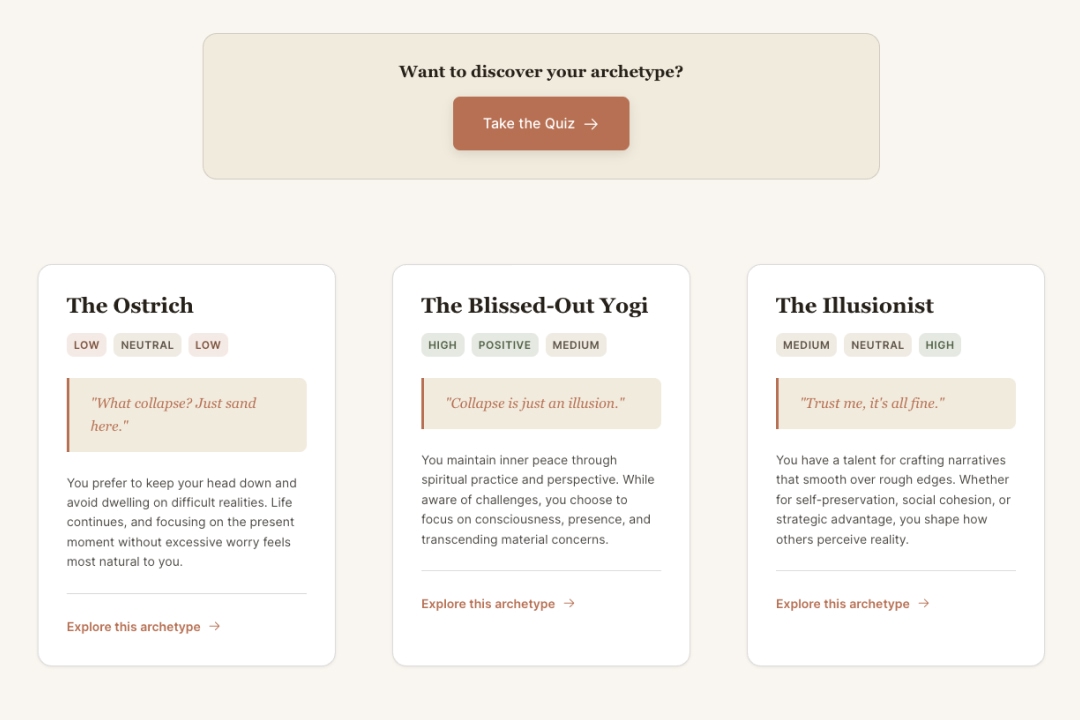
Phase 1: Collapse Archetypes — Initial diagnostic quiz identifying 19 patterns across 6 dimensions (awareness, affect, agency, temporality, relationality, engagement). Grounded in social science frameworks but primarily classificatory.
Phase 2: Adaptation Archetypes — Reframe toward transformative adaptation. Each posture now includes:
- Mirror statement — recognition without judgment
- Shadow — what this posture tends to avoid
- Gift — what it offers during the Great Unravelling
- Companions — adjacent allies and complementary opposites
- Movement edges — where this posture naturally transitions
- Invitations — reflections and practices for growth
Phase 3: Three-Layer Architecture — Progressive disclosure UX surfacing depth without overwhelming. Verb-focused naming (e.g., “Withdrawing” not “The Ostrich”) emphasises posture over identity.
Phase 4: iOS App Development — Planned mobile app version with enhanced interactivity, journaling features, and community sharing archetype matches.
Methodological Approach
Serious play as method: The quiz format creates a reflective container — playful enough to lower defences, structured enough to surface meaningful patterns. Results become conversation starters, not endpoints.
Specification-driven development: Detailed spec created before implementation, including question flow, scoring system (cosine similarity in 6D trait space), and interaction patterns.
Iterative refinement: Initial archetypes developed through personal observation and literature review, refined through user feedback and theoretical grounding.
The 19 Postures
Each posture represents a coherent pattern of relating to systemic stress:
Withdrawing, Denying, Normalising, Prophesying, Performing, Accelerating, Salvaging, Transitioning, Adapting, Playing, Keeping, Collapsing, Transforming, Anchoring, Holding, Grieving, Witnessing, Connecting, Hoping
The verb-focused naming emphasises these as activities, not essences — things we do, not things we are.
Why This Matters
- Reframes collapse responses from pathology to posture — reducing shame, increasing agency
- Bridges psychology and ecology through Adaptive Cycle framing
- Develops serious play methodology for sensitive inquiry domains
- Creates practical tool for educators, facilitators, and mental health professionals working with eco-anxiety and climate grief
Theoretical Lineage
- Joanna Macy — Active Hope, Work That Reconnects
- C.S. Holling — Adaptive Cycle, Panarchy
- Terror Management Theory — Greenberg, Solomon, Pyszczynski
- Deep Ecology — Naess, ecopsychology tradition
- Serious Play — Statler, Roos, organisational research